Web3 promises a decentralized, user-owned internet. But beneath the hype and headlines, a quiet revolution is happening—infrastructure projects are laying the digital foundation for this new ecosystem.
Just like roads, power lines, and internet cables underpin the modern world, Web3 infrastructure ensures blockchain systems are scalable, secure, and interoperable. Without these projects, Web3 apps and services cannot reach a global scale.
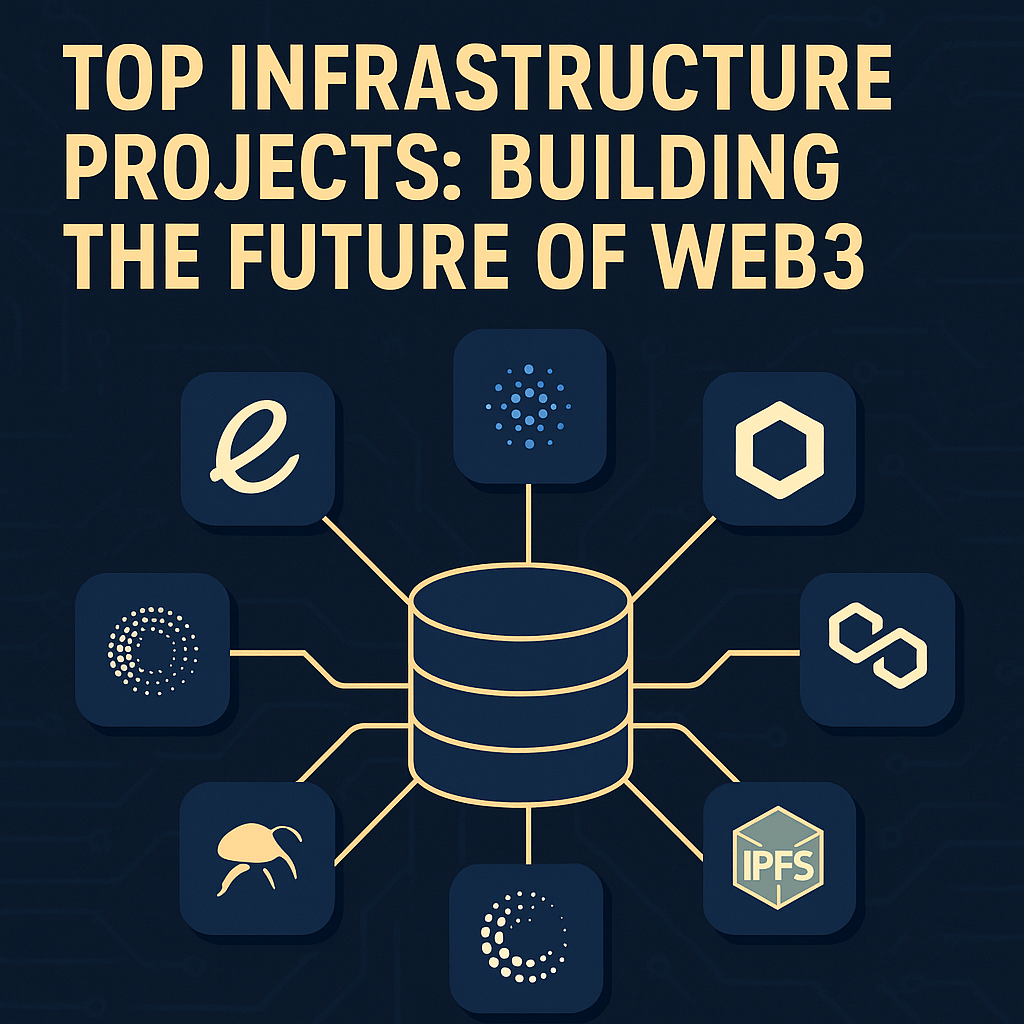
In 2025, several infrastructure projects stand out as core pillars of Web3’s future. Let’s dive into the most important ones—and why they matter.
1. EigenLayer: Restaking for Scalable Security
EigenLayer introduces a new primitive: restaking. It allows Ethereum validators to re-use their staked ETH to secure additional protocols and services.
Why it matters:
- Enables shared security across multiple chains and apps
- Reduces the need for new validator networks
- Promotes decentralization and economic efficiency
EigenLayer turns Ethereum into a “decentralized trust marketplace.” Already in use by oracles, data layers, and rollups, it’s quickly becoming a core layer of modular Web3 architecture.
2. Celestia: Modular Blockchain for Scalable Rollups
Celestia separates consensus from execution. It provides data availability (DA) for rollups, allowing any developer to launch a new blockchain without building a consensus network.
Impact:
- Powers scalable Layer-2 and Layer-3 ecosystems
- Reduces congestion on Ethereum and other L1s
- Makes launching custom blockchains as easy as deploying a smart contract
In 2025, Celestia is the backbone for dozens of rollups, including those powering DeFi, gaming, and decentralized identity.
Read Also: Will Clear Regulations Finally Unlock Mass Adoption?
3. Chainlink: The Oracle Standard
Chainlink remains the most trusted oracle network, bridging blockchain smart contracts with real-world data—like asset prices, weather, and off-chain computation.
Innovations powering Web3:
- CCIP (Cross-Chain Interoperability Protocol) for secure cross-chain messaging
- DECO & OCR for private and secure data delivery
- Partnerships with major banks and traditional institutions (e.g., Swift, DTCC)
Without Chainlink, most DeFi protocols wouldn’t function. It’s the infrastructure that quietly powers billions of dollars in on-chain value.
4. Polygon CDK and zkEVM: Scaling Ethereum Without Compromise
Polygon’s Chain Development Kit (CDK) and zkEVM bring zero-knowledge rollups to mainstream developers.
Contributions to Web3:
- Launch app-specific chains with built-in zk security
- Ethereum compatibility + scalability
- Used by projects like Astar, Immutable, and OKX
As Ethereum’s L2 ecosystem grows, Polygon’s infrastructure is helping onboard millions of users to low-cost, high-speed chains.
5. IPFS & Filecoin: Decentralized Data Storage
Web3 needs decentralized storage for media, metadata, and dApp infrastructure. IPFS (InterPlanetary File System) and Filecoin deliver just that.
Use cases:
- NFT metadata hosting
- Censorship-resistant websites
- Storing dApp frontends and documents
With increasing demand for verifiable data, these storage layers are foundational to a trustless internet.
6. Ankr & Infura: Reliable RPC and Node Services
Every Web3 interaction—wallet login, contract call, token swap—relies on remote procedure calls (RPCs). Ankr and Infura provide robust API infrastructure for developers and dApps.
Benefits:
- Scalable access to Ethereum, BNB Chain, Solana, and others
- High uptime and low-latency connectivity
- Supports millions of Web3 users daily
They act as the plumbing for dApps, wallets, and even entire exchanges.
7. The Graph: Querying the Web3 Data Ocean
The Graph is an indexing protocol that lets developers query on-chain data efficiently.
Why developers love it:
- Creates subgraphs to serve specific datasets
- Powers dashboards, DeFi apps, DAOs, and NFT platforms
- Makes complex data accessible in seconds
Web3 is built on transparency, but The Graph makes that helpful transparency.
Final Thoughts
Web3 is more than a movement—it’s an emerging infrastructure stack for a decentralized digital future. The projects listed above don’t chase hype—they build the bridges, roads, and power lines that make the decentralized internet possible.
In 2025 and beyond, investors and builders should pay close attention to infrastructure. These projects are not only enabling Web3—they’re defining it.
Oluwadamilola Ojoye
Oluwadamilola Ojoye is a seasoned crypto writer who brings clarity and perspective to the fast-changing world of digital assets. She covers everything from DeFi and AI x Web3 to emerging altcoins, translating complex ideas into stories that inform and engage. Her work reflects a commitment to helping readers stay ahead in one of the most dynamic industries today