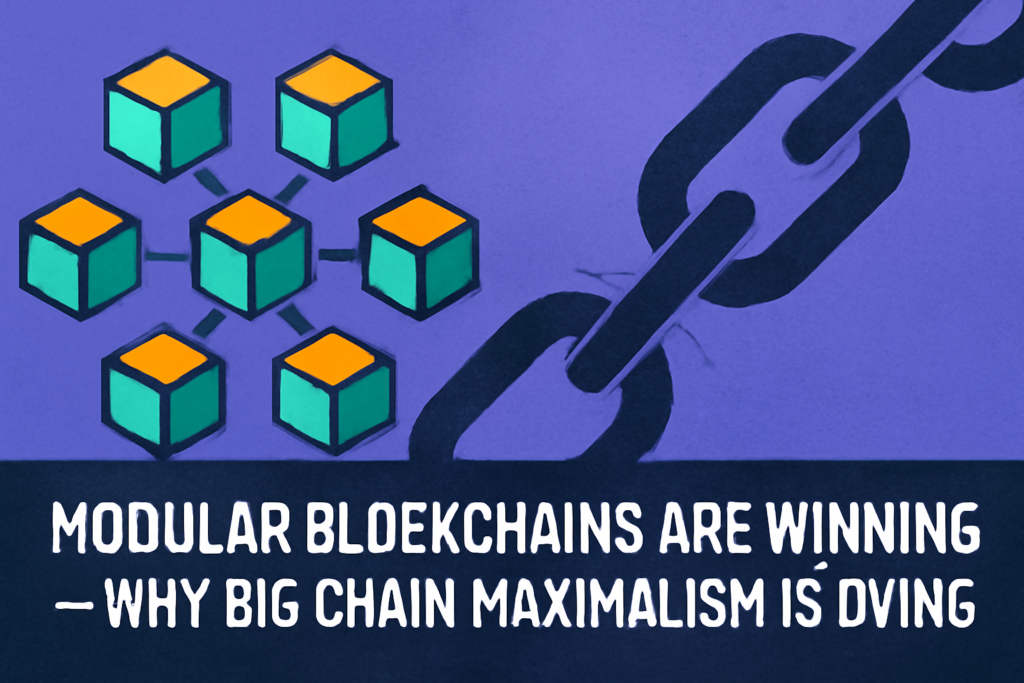
For years, crypto conversations revolved around which Layer-1 would win the race—Ethereum, Solana, Avalanche, or maybe some new contender. But in 2025, that narrative is starting to fade. The focus has shifted. Modular blockchains are gaining momentum rapidly, and the concept of a single “monolithic chain” that runs everything is quickly becoming outdated.
Today’s most forward-thinking developers and investors are betting on composability, scalability, and specialization. They are building modular systems that break up the traditional Layer-1 model and replace it with plug-and-play infrastructure that can evolve over time. And the results are starting to show.
What Are Modular Blockchains?
Unlike traditional monolithic blockchains that handle everything—from consensus to data availability to execution—modular blockchains separate these responsibilities into distinct layers. Each layer can be upgraded, optimized, or replaced independently without affecting the entire system.
Here’s how the layers typically break down:
- Consensus Layer: Confirms and secures transactions
- Data Availability Layer: Ensures that all data required to verify transactions is available
- Execution Layer: Processes smart contracts and dApps
- Settlement Layer: Resolves disputes and finalizes transactions
By breaking these functions apart, modular systems allow developers to fine-tune specific components based on their dApp’s needs. This architecture offers greater flexibility, better performance, and lower costs.
Why Big Chain Maximalism No Longer Works
In the past, many communities rallied behind a single blockchain as the one proper solution. But this mindset no longer matches the complexity of today’s decentralized ecosystem. As more users, applications, and assets enter the space, no single chain can handle everything efficiently.
Big chains often become bottlenecks. High gas fees, slow upgrades, and centralization risks make it hard to scale innovation. Meanwhile, smaller ecosystems struggle to gain traction because they try to do everything at once.
Modular blockchains flip that script. They enable developers to build purpose-specific chains, or “rollups,” that integrate with existing consensus layers, such as Ethereum or Celestia. Each component can evolve independently, freeing up resources and reducing complexity.
Key Modular Projects Leading the Shift
Several modular blockchain projects are already changing the game:
- Celestia: Specializes in data availability. It enables developers to launch their execution layers while relying on Celestia for secure and scalable data storage.
- Avail by Polygon: A data availability layer designed for modular Ethereum-compatible chains.
- Fuel Network: A modular execution layer using optimistic rollups and parallel transaction processing for faster throughput.
- Dymension: Focuses on creating modular rollapps—custom rollup applications built on its shared infrastructure.
These projects give developers building blocks rather than a fixed platform. The result is a more agile ecosystem where dApps can optimize for speed, cost, or decentralization without compromise.
Why Venture Capital Is Flocking to Modular Infrastructure
In 2025, major crypto venture firms are heavily backing modular solutions. They see the writing on the wall. Modular architecture reduces development time, enhances interoperability, and improves scalability—all while enabling the adoption of innovative business models.
Read Also: Crypto Compliance on Autopilot: How Smart Protocols Evade Global Crackdowns
Venture capital is no longer just chasing the next “Ethereum killer.” It is funding projects that quietly and efficiently solve the most challenging infrastructure problems. DePIN (Decentralized Physical Infrastructure Networks), for example, often relies on modular layers to manage IoT networks, storage nodes, or bandwidth markets with minimal latency.
Projects like Akash Network, EigenLayer, and Espresso Systems are now being recognized not just for their tech but for their ability to power the next generation of decentralized infrastructure.
What This Means for Builders and Investors
If you are a builder, modular frameworks let you focus on what matters—your app, your users, your vision. You don’t need to worry about consensus upgrades or chain-wide forks. You just build and deploy.
If you are an investor, modular projects offer exposure to key infrastructure that every future dApp will need. Instead of betting on the next big chain, you are investing in the connective tissue that makes all chains work together.
Final Thought
The future of blockchain is not about choosing the one perfect Layer-1. It’s about building systems that talk to each other, scale together, and evolve without friction. Modular blockchains represent this future.
Big chain maximalism had its moment. But in 2025, it’s the modular builders quietly rewriting the rules of the game.
Oluwadamilola Ojoye
Oluwadamilola Ojoye is a seasoned crypto writer who brings clarity and perspective to the fast-changing world of digital assets. She covers everything from DeFi and AI x Web3 to emerging altcoins, translating complex ideas into stories that inform and engage. Her work reflects a commitment to helping readers stay ahead in one of the most dynamic industries today