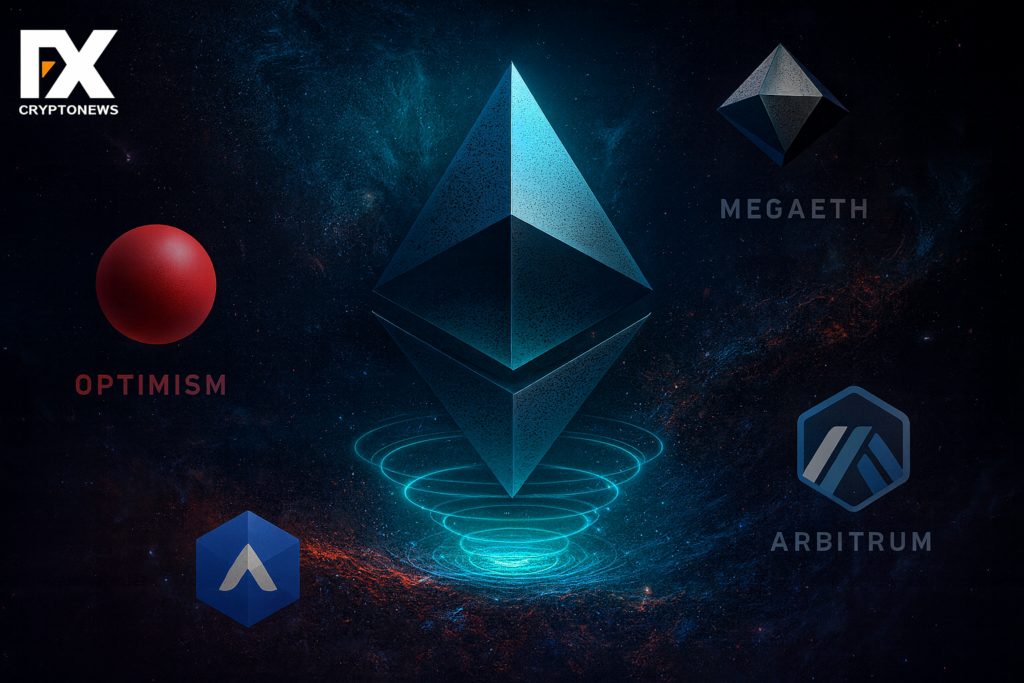
Layer 2 networks are becoming the most competitive part of the Ethereum ecosystem. As more users enter Web3 and decentralized applications grow in demand, the need for cheap and fast transactions becomes stronger. This has created a race among leading Layer 2 platforms, each offering unique scaling solutions and technologies. Analysts believe that the next bull run will be shaped by the L2 that captures the most developers, liquidity and real-world use cases.
In this guide, we compare Base, Arbitrum, Optimism and MegaETH. These four networks are among the best layer 2 coins and scaling ecosystems to watch in 2025. We will explore how they work, what makes each one unique and which might dominate the next wave of Ethereum adoption. If you want clarity on ethereum scaling, zk rollups vs optimistic rollups, eigenlayer explained or what is MegaETH, this article will help you understand the strengths and weaknesses of each L2 competitor.
Why Layer 2 Networks Are Becoming Essential
Ethereum remains the backbone of decentralized finance, NFTs and Web3 applications. However, the base layer can become congested and expensive when demand rises. L2 solutions fix this by processing transactions off chain and settling them securely on Ethereum.
The next bull run may bring millions of new users, which makes fast and affordable networks necessary. This is why investors and developers are watching L2 ecosystems closely. They have the potential to reshape how applications scale and how liquidity flows across Web3. Many analysts expect the majority of Ethereum transactions to occur on Layer 2 networks by 2025.
Arbitrum The Leading L2 in TVL
Arbitrum has become one of the biggest Layer 2 networks in terms of total value locked. It uses optimistic rollups and prioritizes compatibility with existing Ethereum tools. Developers can migrate applications easily and users enjoy significantly lower fees.
Strengths of Arbitrum
- Large DeFi ecosystem
- Strong developer community
- Wide compatibility with Ethereum
- High liquidity and active users
Arbitrum also hosts several major decentralized applications, which increases its network effect. Many investors consider ARB one of the best layer 2 coins because of its maturity and wide adoption.
Potential Weaknesses
- Long challenge periods due to optimistic rollup design
- Competition from zk rollup ecosystems
Despite these challenges, Arbitrum is well positioned to remain a strong contender in 2025.
Optimism and the Superchain Vision
Optimism is another major player in the optimistic rollup category. It is known for its close alignment with Ethereum’s core principles and its long term roadmap known as the Superchain. This initiative aims to link multiple L2 networks, including Base, under a unified framework.
Strengths of Optimism
- Shared governance and funding through the Optimism Collective
- Growing ecosystem backed by major developers
- Partnerships with Coinbase and other institutions
Optimism has become a central part of ethereum scaling efforts thanks to the Superchain concept. If successful, it can create a seamless environment where multiple chains interact as one network.
Potential Weaknesses
- Same challenge period limitations as Arbitrum
- Early stage adoption in some areas
Even with these challenges, OP remains one of the top layer 2 ecosystems that could lead the next market cycle.
Base The Fastest Growing L2 by Adoption
Base, launched by Coinbase, is one of the fastest growing L2 networks in the market. Its main advantage is accessibility. With millions of Coinbase users potentially onboarded into Web3, Base has a clear pathway to mass adoption.
Strengths of Base
- Backed by Coinbase
- Rapid growth in developers and users
- Strong ecosystem of consumer applications
- Low fees and high performance
Base focuses on apps aimed at everyday users, such as gaming, payments and social tools. This gives it an advantage over networks that focus heavily on DeFi alone.
Potential Weaknesses
- No token yet, which limits investor speculation
- Heavy reliance on Coinbase infrastructure
If Base releases a token, analysts expect significant interest. Even without one, Base may dominate consumer onboarding throughout 2025.
What Is MegaETH and Why It Is a Game Changer
MegaETH is one of the newest and most ambitious scaling solutions. Unlike traditional rollups, MegaETH aims to offer real time Ethereum execution at extremely high speeds. It is designed for AI applications, gaming and high throughput environments that current networks struggle to support.
Key Features of MegaETH
- Sub second execution
- Highly optimized communication layer
- Strong focus on decentralized compute
- Advanced scaling beyond typical rollups
MegaETH is not just a rollup. It is an emerging execution layer that reimagines how Ethereum can operate at full scale. If successful, MegaETH could challenge both optimistic and zk rollups by offering performance levels previously thought impossible.
This makes MegaETH one of the most interesting ecosystems for 2025 and a competitor investors should monitor closely.
zk Rollups vs Optimistic Rollups Which Wins 2025
Since Arbitrum and Optimism use optimistic rollups, while MegaETH and other networks may lean toward zk based methods, it is important to understand the difference.
zk Rollups
- Use cryptographic proofs to validate transactions
- Offer faster finality
- Provide stronger security guarantees
- Ideal for long term scaling
Optimistic Rollups
- Assume transactions are valid unless challenged
- Offer wide EVM compatibility
- Easier for developers to build on
zk rollups are seen as the future of Ethereum scaling by many experts. However, optimistic rollups still dominate developer activity due to compatibility advantages.
The next bull run may see both models thrive for different use cases.
How EigenLayer Impacts the L2 Race
EigenLayer introduces restaking, allowing users to reuse staked ETH to secure new services and networks. This has massive implications for L2 networks because it provides shared security and reduces the cost of launching new protocols.
Why EigenLayer Matters
- Enables new rollups to borrow Ethereum’s security
- Increases capital efficiency
- Supports the modular blockchain ecosystem
- Encourages faster innovation
EigenLayer explained simply is a foundational technology that strengthens the entire L2 landscape. Any network integrated with EigenLayer could gain significant advantages in flexibility and performance.
Which L2 Will Dominate 2025
There is no single answer, but analysts predict the following possibilities:
Arbitrum wins if
DeFi continues to dominate and liquidity remains the main driver of growth.
Optimism wins if
The Superchain vision succeeds and multiple networks unify under one framework.
Base wins if
Consumer applications and mainstream adoption become the biggest trend.
MegaETH wins if
High performance applications like AI, gaming and real time systems define the next cycle.
Each network has unique strengths, and the 2025 landscape may support multiple winners rather than one.
Read more: Why Layer 2 Networks Will Dominate the Next Bull Run in 2025
Conclusion
Layer 2 networks are entering the most competitive phase in their history. With growing demand, new technologies and improvements across optimistic rollups, zk rollups and high-performance execution layers, 2025 will be a defining year for Ethereum scaling.
While Arbitrum, Optimism and Base continue to lead in adoption, MegaETH introduces an entirely new class of performance. The winner of 2025 will depend on user needs, developer ecosystems and market trends. Investors should track these networks closely and consider how each one fits into the future of Ethereum.
FAQs
1. What is the difference between Base, Arbitrum and Optimism?
Base focuses on consumer adoption, Arbitrum leads in DeFi liquidity and Optimism relies on the Superchain model for scaling.
2. What is MegaETH?
MegaETH is a high-speed execution layer designed to deliver real-time performance far beyond traditional rollups.
3. Which L2 uses zk rollups?
zkSync, Starknet and other zk rollup platforms use cryptographic proofs for fast and secure scaling.
4. How does EigenLayer affect Layer 2 networks?
EigenLayer enables restaking, which improves security and makes it easier to launch new L2 and infrastructure services.
5. Which Layer 2 has the best chance of winning 2025?
It depends on the narrative. Arbitrum may win DeFi, Base may win mass adoption, Optimism may win unified scaling and MegaETH may win high-performance computing.
Lanre Durojaiye
Mr. Durojaiye Olusola is a finance graduate and cryptocurrency writer with over a year of experience providing market insights and clear, well-researched analysis. Dedicated to helping readers understand blockchain trends and digital asset developments.